

Medically Reviewed by
DR. MIR JAWAD ZAR KHANMBBS, MS - Orthopedic
M.CH-(Ortho) Joint
Replacement surgeon
Partial vs Total Knee Replacement: Key Differences, Candidates and Recovery
If arthritis has worn down your knee and non-surgical care is no longer enough, your surgeon may talk to you about knee replacement. One of the first choices is between a partial knee replacement and a total knee replacement. They are different operations, suited to different patients, with different recovery journeys. This guide from Dr. Mir Jawad Zar Khan, senior joint replacement surgeon and Chairman of Germanten Hospitals in Hyderabad, explains the difference in plain language so you know what to expect and what to ask.
Quick Definitions: TKR Meaning and the Three Compartments
The knee has three parts, called compartments: the inner side (medial), the outer side (lateral), and the front where the kneecap sits (patellofemoral). Knowing this makes the two surgeries easy to understand.
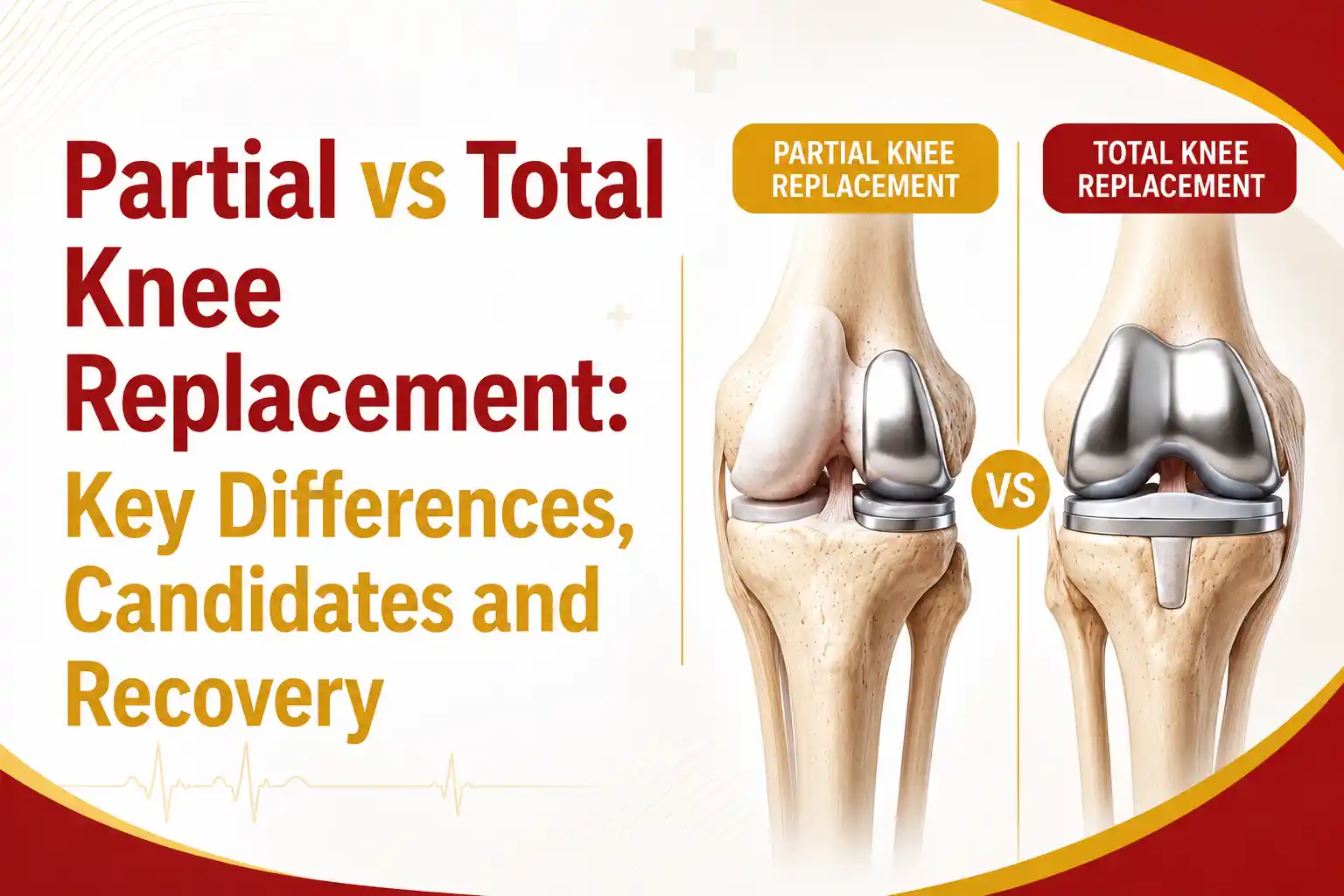
- Partial knee replacement, also called unicompartmental knee replacement, replaces only the single damaged compartment and leaves the healthy parts of the knee untouched.
- Total knee replacement, often shortened to TKR, means the surfaces of all three compartments are replaced with an artificial joint. That is what the abbreviation TKR stands for.
Partial Knee Replacement: How It Works
In a partial knee replacement surgery, the surgeon resurfaces just the worn compartment, most commonly the inner (medial) side, which is where arthritis often strikes first. Because the bone, cartilage, and ligaments in the healthy parts of the knee are preserved, the joint tends to feel more natural afterwards. This procedure uses a smaller incision and removes less bone than a total replacement.
Advantages of Partial Knee Replacement
- Quicker recovery and a faster return to daily activities.
- Less pain after surgery and less blood loss.
- A lower risk of infection and blood clots.
- A more natural-feeling knee, because your own ligaments and healthy cartilage are kept, often with better range of motion.
The Main Trade-Off
The chief disadvantage of a partial knee replacement is the possibility of needing more surgery later. If arthritis develops in the parts of the knee that were not replaced, a total knee replacement may be needed in the future. The chance of needing a further procedure is slightly higher than with a total replacement from the start. When performed on well-selected patients, however, modern partial knee implants have shown excellent long-term survivorship. Studies report that around 90 percent of unicompartmental replacements are still performing well ten years after surgery in suitable patients.
Total Knee Replacement: How It Works
A total knee replacement resurfaces all three compartments of the knee. It is the right choice when arthritis or damage is widespread across the joint, when pain is felt throughout the knee rather than in one spot, or when there is significant deformity or instability. TKR is one of the most successful operations in modern medicine, with high satisfaction rates and reliable, long-lasting pain relief for people with advanced arthritis.
Types of Total Knee Replacement
Total knee replacement is not a single fixed procedure. The main variations you may hear about include:
- Cemented versus uncemented implants, describing how the components are fixed to the bone.
- Cruciate-retaining versus posterior-stabilised designs, describing how the implant handles the knee ligaments.
- Fixed-bearing versus mobile-bearing implants, describing how the plastic spacer moves.
- Manual, computer-navigated, or robotic-assisted techniques, describing how the surgery is planned and performed.
Your surgeon selects the type based on your age, activity level, bone quality, and knee anatomy. If you would like to understand the robotic option, see the companion post on robotic versus traditional knee replacement .
Partial vs Total: A Side-by-Side Comparison
| Factor | Partial (Unicompartmental) | Total (TKR) |
|---|---|---|
| What is replaced | One damaged compartment | All three compartments |
| Best suited for | Arthritis limited to one area | Widespread arthritis or deformity |
| Incision and bone removed | Smaller, less bone | Larger, more bone |
| Recovery speed | Usually faster | Longer but well established |
| Feel of the knee | Often more natural | Very good, fully resurfaced |
| Main trade-off | Slightly higher chance of later surgery | Larger operation up front |
Who Is a Candidate for Partial Knee Replacement?
Partial knee replacement is not suitable for everyone. It works best when the arthritis is genuinely limited to one compartment. Good candidates usually have:
- Pain located almost entirely on the inner or outer side of the knee, rather than throughout the joint.
- Arthritis confined to a single compartment on imaging.
- Stable ligaments and reasonable knee movement.
- No significant deformity of the leg.
If pain is spread across the whole knee, or under the kneecap, a total knee replacement is generally the better choice. A careful assessment with an orthopedic surgeon, including an examination and X-rays, is the only reliable way to know which procedure fits. Choosing an experienced partial knee replacement surgeon matters, because correct patient selection is what makes this operation succeed.
Recovery and How Long Surgery Takes
Both operations are followed by early mobilisation and physiotherapy, but the timelines differ. Because a partial replacement disturbs less tissue, many patients recover more quickly and return to routine activities sooner. A total knee replacement has a longer, very well-understood recovery path, with steady gains over several weeks and months. As a general guide, a partial knee replacement surgery often takes around one to one and a half hours, though the exact time depends on your knee and the surgical plan. Whichever procedure you have, your commitment to rehabilitation, weight management, and follow-up reviews is the biggest driver of a strong result.
Conclusion
Partial and total knee replacement are both excellent operations when matched to the right patient. A partial knee replacement preserves more of your natural knee and offers a quicker recovery, but it depends on the arthritis being confined to one compartment. A total knee replacement is the dependable answer for widespread joint damage. The right choice is a shared decision, guided by your symptoms, your imaging, and an honest conversation with an experienced surgeon.
Find Out Which Knee Replacement Is Right for You
Book a consultation with Dr. Mir Jawad Zar Khan at Germanten Hospitals, Hyderabad. As a senior joint replacement surgeon with training in Germany and more than 10,000 procedures, Dr. Jawad will assess your knee and recommend the least invasive option that gives a lasting result.
Schedule Your AppointmentFrequently Asked Questions
What does TKR mean?
TKR stands for total knee replacement, an operation that resurfaces all three compartments of the knee with an artificial joint.
Is partial knee replacement better than total?
Neither is universally better. Partial is excellent when arthritis is limited to one compartment and offers faster recovery and a more natural feel. Total is the right choice for widespread arthritis. The best option depends on your knee.
How long does a partial knee replacement surgery take?
It commonly takes about one to one and a half hours, but the precise duration varies with your anatomy and the surgical plan. Your surgeon can give you a more exact estimate.
Does a partial knee replacement last as long as a total?
In well-selected patients, modern partial implants show excellent longevity, with around 90 percent still performing well at ten years. The main reason a partial may need revision is arthritis developing in the other compartments.
Can a partial knee replacement be converted to a total later?
Yes. If arthritis spreads to the rest of the knee over time, a partial replacement can be converted to a total knee replacement.
References


DR. MIR JAWAD ZAR KHAN
MBBS, MS - Orthopedic, M.CH-(Ortho) Joint Replacement Surgeon
As the visionary Chairman and Managing Director of Germanten Hospitals, Hyderabad, Dr. Mir Jawad Zar Khan brings over two decades of surgical leadership to the field. He is dedicated to transforming lives through evidence-based treatments, advanced robotic technology, and a commitment to patient quality of life.