

Medically Reviewed by
DR. MIR JAWAD ZAR KHANMBBS, MS - Orthopedic
M.CH-(Ortho) Joint
Replacement surgeon
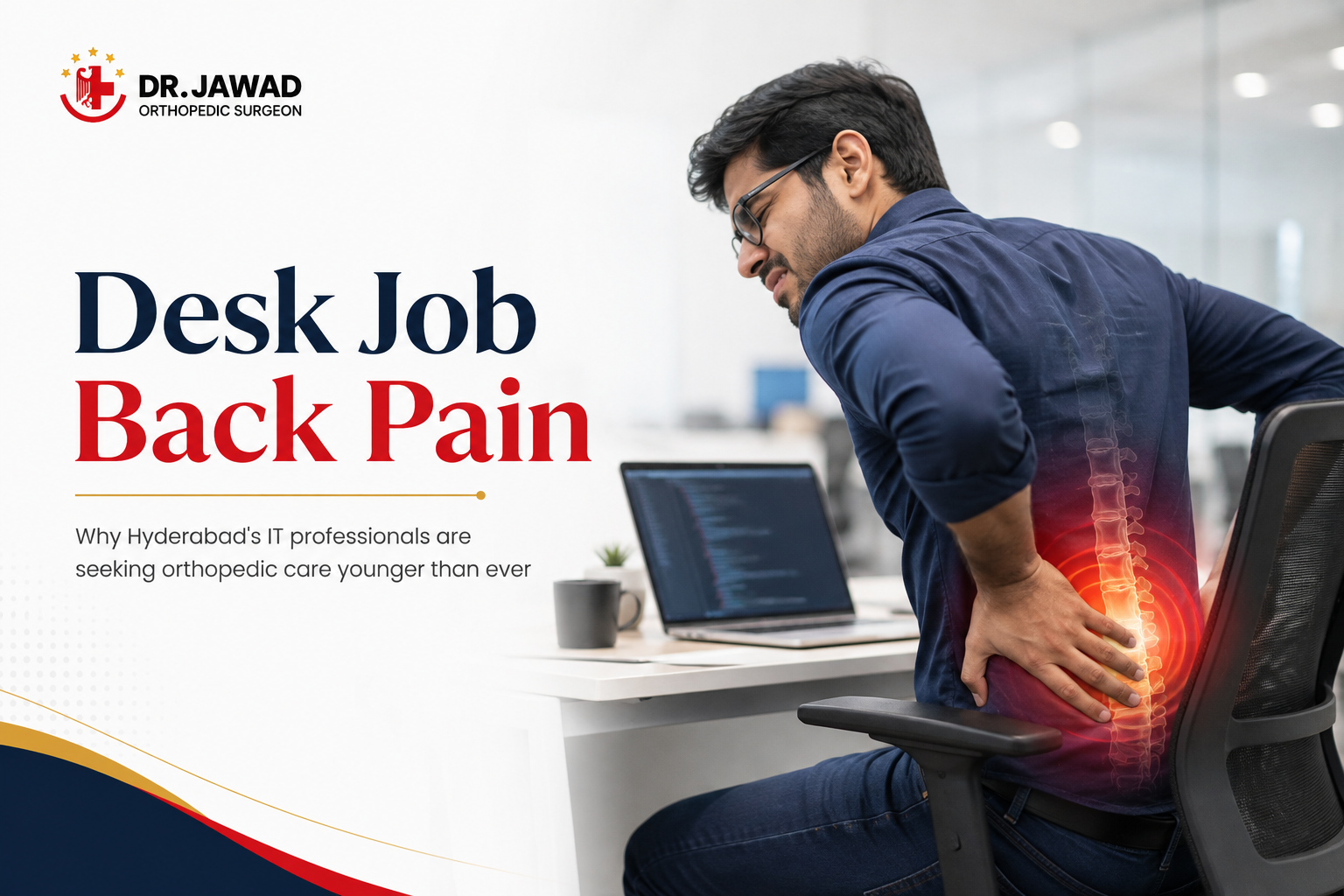
Desk Job Back Pain: Why Hyderabad's IT Professionals Are Seeing an Orthopedic Surgeon Younger Than Ever
Hyderabad's IT corridor runs on long hours at a desk. Across Hitech City, Gachibowli, Madhapur and the Financial District, hundreds of thousands of professionals spend eight to twelve hours a day in front of a screen. The result is showing up in orthopedic clinics as a clear trend: back and neck pain arriving a decade earlier than it used to. Conditions that once appeared in a person's fifties are now common in people barely into their thirties. If your lower back aches by the end of the workday or your neck feels stiff every evening, you are part of a pattern that doctors across the city are watching closely.
A Problem That Is Arriving Younger
Musculoskeletal pain, particularly of the back and neck, is now one of the most common health complaints among young working professionals in Hyderabad. Local reporting has highlighted how long desk hours are driving neck pain, headaches and back problems in people well under 40, an age group that historically did not feature much in spine clinics.
The World Health Organization lists musculoskeletal conditions, including low back pain, as a leading cause of disability worldwide. What has changed is the age of onset. Sedentary work, poor posture and very little daily movement are compressing decades of wear into a much shorter span, which is why the average back pain patient in an IT hub is younger than ever.
Why Desk Work Hurts Your Spine
Sitting feels restful, but for the spine it is surprisingly demanding, especially when it goes on for hours without a break.
- Prolonged sitting loads the lower back When you sit, particularly if you slouch, the discs in your lower spine carry more pressure than they do when you stand or walk. Hold that position for hours a day, five or six days a week, and the constant load gradually strains the discs, ligaments and muscles that support the spine.
- Forward head posture strains the neck Leaning toward a monitor or looking down at a laptop pushes the head forward of its natural position. The further forward the head sits, the harder the neck and upper back muscles have to work to hold it up. Over time this produces the stiff, aching neck and shoulders that so many desk workers describe.
- Weak core and tight hips Sitting all day leaves the core muscles underused and the hip flexors tight and shortened. A weak core means the spine loses some of its natural support, and tight hips pull on the lower back, both of which feed into chronic pain.
- Too little movement The human spine is built to move. Long unbroken stretches of stillness reduce blood flow to spinal tissues and let muscles stiffen. The problem is often not any single bad posture but the sheer number of hours held in one position.
Warning Signs You Should Not Ignore
Occasional stiffness after a long day is normal. These symptoms are not, and they mean it is time to have your spine evaluated.
- Back or neck pain that persists for more than two to three weeks
- Pain that radiates from the back or neck down into a leg or arm
- Numbness, tingling or a pins and needles feeling in the limbs
- Weakness or a heavy feeling in an arm or leg
- Pain that wakes you at night or is worse in the morning
- Stiffness that no longer eases with rest, stretching or a change of position
Pain that spreads into a limb, or that comes with numbness or weakness, can point to a nerve being compressed in the spine, for example by a slip disc. This is exactly the kind of problem that responds well to early, mostly non surgical treatment and gets harder to manage the longer it is left.
What You Can Do Right Now
Most desk related back and neck pain can be prevented or eased with a few consistent habits.
- Move every 30 to 45 minutes Stand, stretch or walk for a couple of minutes at regular intervals. This single habit does more than any expensive chair. Set a reminder if you need to.
- Fix your screen and chair setup Position the top of your monitor at eye level so you are not looking down. Keep your feet flat on the floor, your back supported, and your elbows at roughly a right angle. A small cushion in the curve of your lower back helps a great deal.
- Strengthen your core Regular core and back strengthening exercises give the spine the support that sitting takes away. Even short daily routines make a measurable difference over weeks.
- Do not push through worsening pain Mild stiffness is manageable at home. Pain that is getting worse, spreading or lingering is a signal to get it assessed rather than to keep working through it.
When to See an Orthopedic Specialist
Seeing a specialist early is not an overreaction, it is the sensible move. A proper evaluation identifies whether your pain is a simple muscular strain that good habits will fix, or an early spine problem that benefits from guided treatment. The vast majority of back and neck problems in desk workers are treated without surgery, through physiotherapy, posture correction, targeted exercise and, where needed, non surgical spine treatments.
The mistake many young professionals make is assuming back pain is just part of the job and waiting until it becomes constant. Early assessment keeps treatment simple and keeps you working comfortably.
Simple Desk Exercises You Can Do Between Meetings
You do not need to leave your workstation to protect your spine. These take under a minute and can be done through the day.
- Seated spinal twist Sitting tall, place one hand on the opposite knee and gently rotate your upper body to that side, hold for a few seconds, then switch. This eases tension across the mid and lower back.
- Neck and shoulder rolls Slowly roll your shoulders backward several times, then gently tilt your head from side to side. This releases the tightness that builds in the neck and upper back from screen work.
- Chin tucks for forward head posture Gently draw your chin straight back, as if making a double chin, hold briefly and release. This directly counters the forward head position that laptops encourage.
- Standing back extension Stand up, place your hands on your lower back and gently arch backward a small amount. Doing this every time you stand up reverses hours of forward bending.
How Desk-Related Spine Problems Are Diagnosed
When back or neck pain from desk work does not settle, a specialist first takes a history of your symptoms and daily routine, then examines your movement, posture and any signs of nerve involvement such as altered sensation or weakness. This alone often points to the cause. If a nerve related problem such as a slip disc is suspected, imaging like an MRI gives a clear picture of the discs and nerves. The purpose is not to rush toward surgery but the opposite: to identify exactly what is happening so the least invasive effective treatment can be chosen, which for desk workers is almost always physiotherapy, exercise and posture correction.
Building Spine-Friendly Habits That Last
The professionals who escape chronic back and neck pain are rarely the ones with the most expensive chairs. They are the ones who move regularly, keep their core reasonably strong and do not ignore early warning signs. Small habits repeated daily beat occasional big efforts. If your work involves long hours at a screen, treat movement as part of the job rather than an interruption to it. A two minute stretch every hour, a proper lunch break away from the desk, and a short walk each day protect your spine far more effectively than any single intervention.
Conclusion
Back and neck pain among Hyderabad's IT professionals is common, and it is showing up younger because of how modern desk work loads the spine. The encouraging part is that it is also very preventable and, when caught early, very treatable. Regular movement, a sensible desk setup and a strong core protect most people. When pain persists, spreads into a limb, or brings numbness or weakness, an orthopedic evaluation is the right next step rather than something to postpone.
Struggling with back or neck pain from long desk hours? Dr. Jawad at Germanten Hospitals, Attapur, offers expert spine evaluation and mostly non surgical treatment. Call 9989635555 to book an appointment.


DR. MIR JAWAD ZAR KHAN
MBBS, MS - Orthopedic, M.CH-(Ortho) Joint Replacement Surgeon
As the visionary Chairman and Managing Director of Germanten Hospitals, Hyderabad, Dr. Mir Jawad Zar Khan brings over two decades of surgical leadership to the field. He is dedicated to transforming lives through evidence-based treatments, advanced robotic technology, and a commitment to patient quality of life.