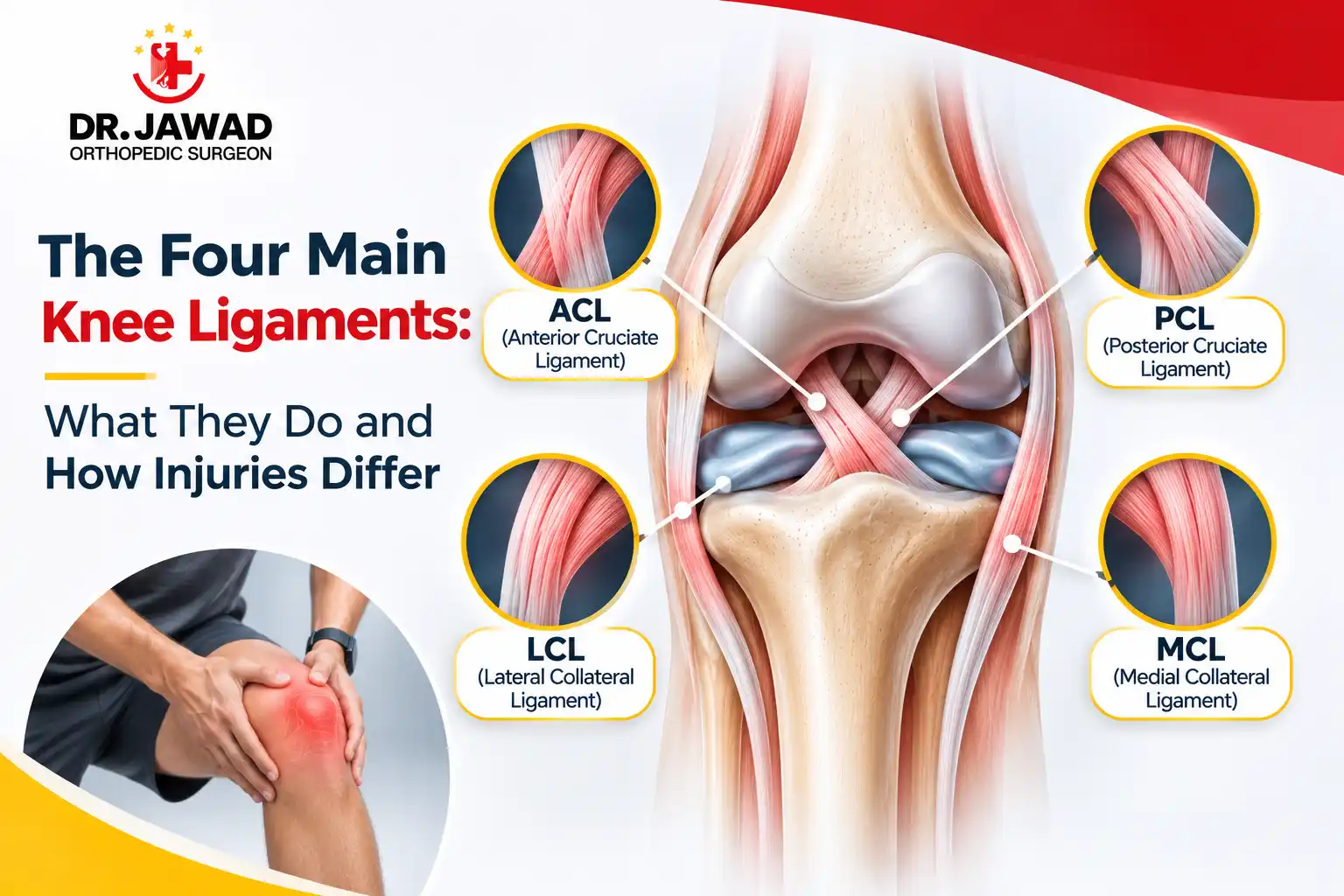
Anatomical illustration showing the ACL, PCL, MCL and LCL in the knee.

Medically Reviewed by
DR. MIR JAWAD ZAR KHANMBBS, MS - Orthopedic
M.CH-(Ortho) Joint
Replacement surgeon
You twist your knee while changing direction, or land awkwardly and feel it give way. Soon the joint is swollen, and every search result seems to mention a different ligament. Understanding the knee ligaments can help you describe what happened and recognise when the injury needs assessment. It cannot tell you which ligament is torn without an examination.
Four main ligaments help keep the knee stable: the anterior cruciate ligament (ACL), posterior cruciate ligament (PCL), medial collateral ligament (MCL) and lateral collateral ligament (LCL). They resist different movements, so the force that caused an injury and the symptoms that follow can offer clues. This guide explains those differences, what tests may be useful and why treatment is not the same for every tear.
What are the four main knee ligaments?
A ligament is a strong band of tissue that connects one bone to another. The knee joins the thigh bone, or femur, to the shin bone, or tibia. Two cruciate ligaments cross inside the joint. Two collateral ligaments support its sides. Together with the muscles and other tissues around the knee, they help control movement when you walk, turn, land and climb stairs.
Anterior cruciate ligament (ACL)
The ACL lies inside the knee and helps prevent the shin bone from sliding too far forward relative to the thigh bone. It also helps control rotation when you change direction. A sudden stop, pivot or awkward landing can injure it, sometimes without another person hitting the knee. People may hear or feel a pop and notice rapid swelling or later episodes of giving way. If instability persists and you want to return to pivoting sport, an assessment can clarify whether rehabilitation or ACL reconstruction surgery in Hyderabad is appropriate.
Posterior cruciate ligament (PCL)
The PCL also sits inside the knee, crossing the ACL. It helps prevent the shin bone from sliding too far backward. A forceful blow to the front of a bent knee, such as the knee striking a dashboard in a road accident, is a recognised cause. A hard fall onto a bent knee can also injure it. Pain, swelling and trouble going down stairs may follow, but a PCL injury can be less obvious than an ACL tear. More severe trauma may damage several structures at once.
Medial collateral ligament (MCL)
The MCL runs along the inner side of the knee and resists excessive sideways movement. A blow to the outside of the knee can force the joint inward and injure the MCL. Twisting while the foot stays planted can do the same. Pain and tenderness are often felt along the inner side. Many isolated MCL injuries improve with protection and rehabilitation, although a clinician must check for an associated meniscus or cruciate ligament injury.
Lateral collateral ligament (LCL)
The LCL supports the outer side of the knee and resists excessive movement in the opposite direction. It can be injured by a blow to the inside of the knee or a forceful twist. Tenderness may be felt on the outer side. An LCL injury deserves careful assessment because it can occur with damage to other stabilising structures, and some severe injuries may need surgery.
How do knee ligament injuries differ?
The direction of force is useful information. A pivot or awkward landing often raises concern for the ACL. A direct blow to the front of a bent knee raises concern for the PCL. Sideways force can injure an MCL or LCL, depending on which way the knee is pushed. These patterns are clues, not a home diagnosis: one accident can damage more than one ligament, a meniscus or a bone.
The symptoms can overlap. Pain, swelling, stiffness and difficulty walking occur with many knee injuries. A knee that repeatedly gives way suggests a stability problem, but it does not identify the exact ligament. Catching or locking may indicate a meniscus injury or another problem inside the joint. Tell your clinician how quickly the swelling appeared and whether you could continue your activity.
Can a popping sound tell you which knee ligament is torn?
No. A pop can happen with a ligament injury, but it does not identify the ACL, PCL, MCL or LCL. Swelling, instability, the injury mechanism and a clinical examination provide better clues.
People often remember the sound more clearly than the position of their knee. It helps to reconstruct the event: Was your foot planted as you turned? Did someone hit the side of your leg? Did you land on a bent knee? Bring that account to the appointment, but avoid repeatedly testing whether the knee will give way.
Can more than one knee ligament be injured at once?
Yes. A strong twist, collision or road accident can damage several ligaments and the meniscus or blood vessels. Combined injuries need timely assessment because treatment and recovery can differ.
An ACL tear can occur with an MCL or meniscus injury, while serious PCL trauma may involve other ligaments. Severe pain, major swelling, a changed shape or new problems in the foot need prompt assessment.
What symptoms need prompt or urgent care?
Seek prompt medical assessment after a knee injury if you cannot put weight on the leg, cannot straighten the knee, develop a large amount of swelling quickly, or the knee repeatedly gives way. A joint that locks or changes shape also needs assessment. These symptoms can reflect a ligament tear, a meniscus injury, fracture or another problem.
Go to emergency care after major trauma or a possible knee dislocation, especially if the foot becomes cold, pale, numb or weak. These may be signs of a circulation or nerve injury. A hot, red, swollen knee with fever or feeling unwell also needs urgent medical attention, even if you do not recall a twist.
Until you are assessed, avoid sport or movements that make the knee buckle. Support the leg, reduce weight bearing if needed, and use a wrapped cold pack for short periods. Do not put ice directly on the skin. Pain relief may be helpful, but check with a clinician or pharmacist if you have other conditions or are unsure which medicine is safe.
How are knee ligament injuries assessed?
Assessment begins with the story of the injury: the direction of the force, whether you heard a pop, how quickly swelling developed and whether you could walk afterwards. The clinician will examine the knee when pain allows, checking tenderness, range of movement and stability. They may also assess the foot's feeling and circulation, especially after a high-energy injury.
An X-ray is useful when a fracture or joint dislocation is a concern; it does not show a ligament tear directly. An MRI can show ligaments, the meniscus and other soft tissues when the result is likely to change the diagnosis or treatment plan. A clinician may recommend imaging after examining the knee rather than ordering every test immediately.
The important outcome is a clear diagnosis and a plan for safe recovery. If the initial swelling makes the examination difficult, follow-up may be needed as it settles. If you have already had imaging, ask which findings explain your symptoms and whether any injury involves more than one structure.
Does every suspected knee ligament sprain need an MRI?
No. A history and examination guide the first steps, and an X-ray may be needed after trauma. MRI is considered when a ligament or meniscus injury is suspected and its result could change care.
A scan is useful for the right question, but it cannot replace a careful examination. A small sprain with improving symptoms may be managed differently from a knee that repeatedly gives way or cannot straighten. Your clinician can explain why imaging is or is not useful in your case.
Do the four knee ligaments need different treatment?
Yes. The plan depends on which ligament is injured, whether the tear is partial or complete, whether other structures are damaged, and how stable the knee feels during everyday activity. Your job, sport and goals matter too. A grade or scan description alone should not decide the treatment.
Many MCL injuries improve with a brace when prescribed, a gradual return to movement and physiotherapy. Some milder isolated LCL injuries can also recover without surgery, but more severe LCL and combined injuries need specialist review. If the side of your knee remains painful or unstable, ask about MCL and LCL injury treatment in Hyderabad after an assessment has defined the injury.
Not every ACL tear needs an operation. Physiotherapy and changes to activity can help some people function well, while persistent giving way, associated damage or a goal of returning to demanding pivoting sport may lead to a discussion about reconstruction. An isolated PCL injury may also be managed with bracing and rehabilitation; severe instability or damage to other ligaments may change that plan. A specialist can explain when PCL reconstruction surgery in Hyderabad is relevant.
Rehabilitation matters whether or not surgery is chosen. Early goals often include reducing swelling and regaining comfortable movement. Later work focuses on strength, balance and confidence before a return to more demanding activities. Avoid using someone else's recovery timetable as your own; the injured structures and treatment plan determine the pace.
When should you consult a knee specialist?
Arrange a review if swelling and pain are not improving, your knee repeatedly gives way, you cannot return to normal activities, or you are unsure whether an MRI result requires treatment. A specialist can also help if you have a known ligament tear and need to weigh rehabilitation against surgery. Bring previous scans and explain the movements or activities that feel unsafe.
For knee pain and ligament injury treatment in Hyderabad , Dr. Mir Jawad Zar Khan's team can assess the injury and discuss a plan based on stability, associated damage and your goals. If you have the urgent warning signs above, seek emergency care first.
Conclusion
The ACL and PCL control movement inside the knee, while the MCL and LCL support its sides. How an injury happened can suggest which ligament is involved, but symptoms often overlap and combined injuries are possible. An examination, with imaging when useful, is the way to identify the problem.
Many knee ligament injuries can be managed with protection and rehabilitation. Surgery is considered when instability, associated damage and activity needs make it appropriate. If the knee gives way, remains swollen or prevents you from doing normal activities, seek an individual assessment rather than relying on the injury label alone.
Experiencing knee pain, swelling or instability after an injury? Consult Dr. Mir Jawad Zar Khan's team at Germanten Hospitals, Attapur, Hyderabad, for an orthopaedic assessment and an individual treatment plan.
Call 9989635555Frequently Asked Questions
What are the four main ligaments of the knee?
The four main knee ligaments are the ACL and PCL inside the joint, and the MCL and LCL on its inner and outer sides. They help control forward, backward and sideways movement and keep the knee stable.
Which knee ligament is most commonly injured?
The ACL is a common knee ligament injury, especially in sports involving sudden stops, pivots or awkward landings. The MCL is also frequently injured. The exact ligament involved cannot be confirmed from symptoms alone.
Can an MCL or PCL injury improve without surgery?
Yes. Many isolated MCL injuries and some isolated PCL injuries can be managed with protection, bracing when prescribed and rehabilitation. Severe instability or damage to other structures may change the recommendation.
When should I consult Dr. Mir Jawad Zar Khan for a knee ligament injury?
Consult Dr. Mir Jawad Zar Khan if your knee remains swollen, repeatedly gives way, limits walking or sport, or you need help understanding a scan and treatment choices. Seek urgent care first if you cannot bear weight or your foot is cold or numb.
Can Dr. Mir Jawad Zar Khan assess whether I need knee ligament surgery?
Yes. Dr. Mir Jawad Zar Khan can assess your knee, review appropriate imaging and discuss rehabilitation and surgical options. The decision depends on which ligaments are injured, knee stability, associated damage and your goals.
References
- MedlinePlus, US National Library of Medicine: Anterior cruciate ligament injury
- MedlinePlus, US National Library of Medicine: Posterior cruciate ligament injury
- MedlinePlus, US National Library of Medicine: Collateral ligament injury
- NHS: Why ACL surgery is done
- NHS: Knee pain and urgent symptoms
- Royal Cornwall Hospitals NHS Trust: Suspected LCL injury
- North Tees and Hartlepool NHS Foundation Trust: ACL injury
Medical Note: This article is for general educational purposes only and does not replace professional medical advice. Consult a qualified healthcare professional for personalised guidance.


DR. MIR JAWAD ZAR KHAN
MBBS, MS - Orthopedic, M.CH-(Ortho) Joint Replacement Surgeon
As the visionary Chairman and Managing Director of Germanten Hospitals, Hyderabad, Dr. Mir Jawad Zar Khan brings over two decades of surgical leadership to the field. He is dedicated to transforming lives through evidence-based treatments, advanced robotic technology, and a commitment to patient quality of life.