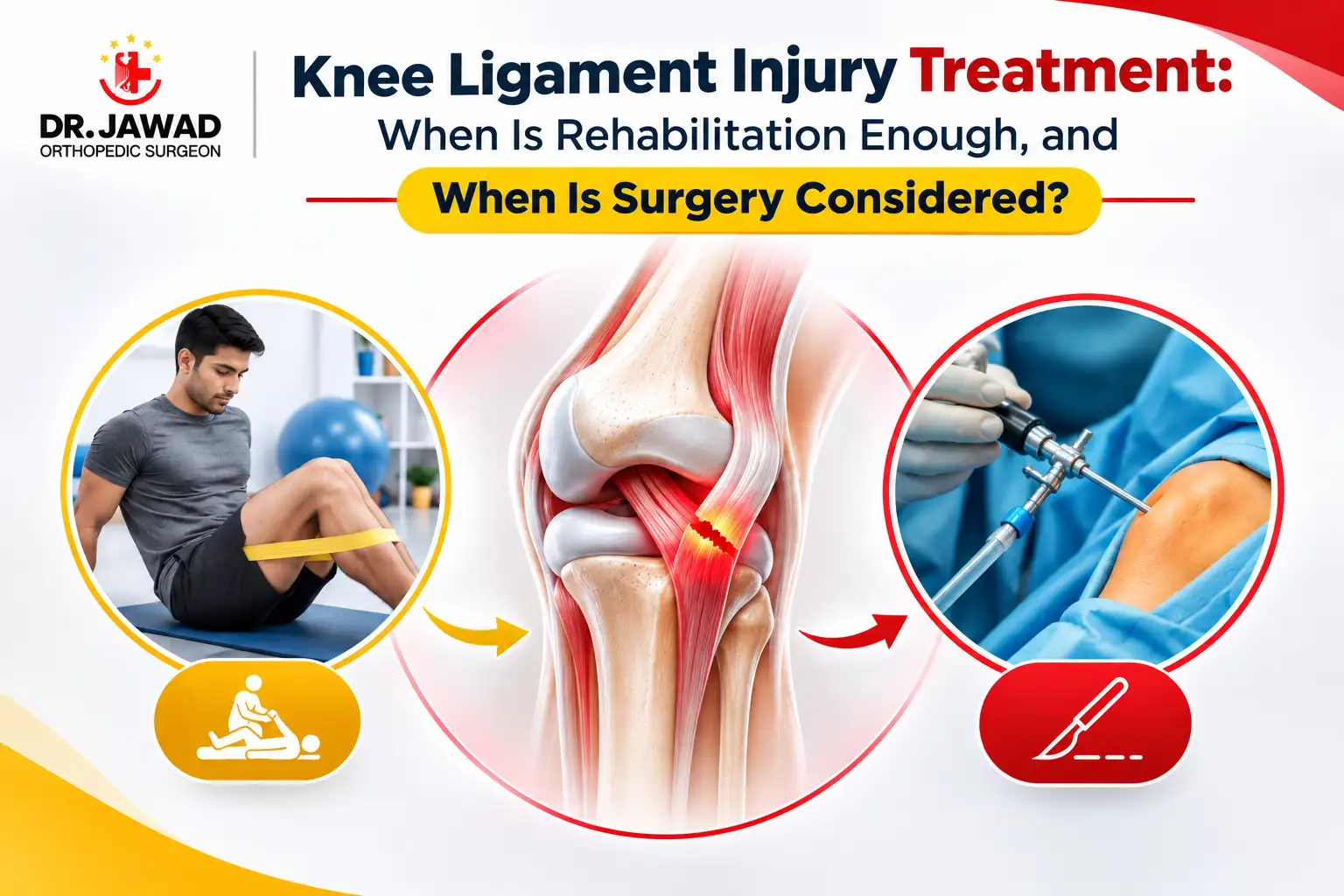
Image Disclaimer: AI-generated illustration for educational purposes.

Medically Reviewed by
DR. MIR JAWAD ZAR KHANMBBS, MS - Orthopedic
M.CH-(Ortho) Joint
Replacement surgeon
A sudden twist, a pop and a swollen knee can leave you with one urgent question: Will this heal with physiotherapy, or will I need an operation?
The answer depends on much more than the words "ligament tear" on an MRI report. Knee ligament injury treatment depends on how stable the joint feels in everyday life, the ligament involved, other damage inside the knee and your activity goals.
Many people recover with structured rehabilitation. Others need surgery to restore stability or treat an associated injury. A careful examination, followed by imaging when needed, helps guide the decision.
Which knee ligament is injured, and why does it matter?
Four main ligaments help keep the knee steady. The anterior cruciate ligament (ACL) and posterior cruciate ligament (PCL) sit inside the joint and help control forward, backward and rotational movement. The medial collateral ligament (MCL) runs along the inner side; the lateral collateral ligament (LCL) runs along the outer side. The MCL and LCL resist unwanted side-to-side movement.
An injury can stretch a ligament, partly tear it or completely tear it. A "complete tear" does not automatically mean surgery. An isolated MCL tear may be treated differently from an ACL tear in a person who plays pivoting sports. A PCL injury after a road accident needs a check for other damage. The whole knee matters, not one line of a scan.
What symptoms suggest a knee ligament injury?
People describe a pop, immediate pain or swelling, difficulty continuing an activity, or a knee that feels as though it might buckle. The pain may be on the inner or outer side of the knee after an MCL or LCL injury. An ACL injury often follows a quick change of direction or awkward landing. A PCL injury can follow a blow to the front of a bent knee, such as during a fall or vehicle collision.
These clues cannot identify the exact injury on their own. A torn meniscus or fracture can also cause swelling or trouble walking. Repeated giving way, a knee that will not fully straighten, or rapid swelling deserves prompt assessment. Do not test an unstable knee by returning to sport.
How is a knee ligament tear diagnosed?
Your clinician will ask how the injury happened, when swelling appeared, whether the knee has given way, and what you need it to do. They will examine movement, tenderness and stability, usually comparing both knees. A repeat examination may help if swelling limits the first assessment.
An X-ray does not show a ligament tear directly, but it can help check for a fracture. An MRI can show the ligaments, menisci and cartilage, and may help map out a complex injury. It is not a substitute for a clinical examination: the scan and your symptoms need to make sense together.
Ask your specialist to explain which ligament is injured, whether the knee is clinically unstable, and whether the meniscus, cartilage or bone is also involved. Those answers shape the next step.
Knee ligament injury treatment: Rehabilitation or surgery?
Ask, "Can this knee become stable enough for my usual activities with rehabilitation?" Think about uneven ground, stairs, work and sport. Age alone does not settle the issue; activity demands matter too.
When rehabilitation may be enough
A mild or moderate isolated MCL injury often responds to protection, sometimes a hinged brace, and a progressive physiotherapy plan. A stable, lower-grade isolated LCL injury may also be managed without surgery, although more severe outer-side injuries need careful evaluation. An isolated PCL injury can sometimes recover well with bracing and rehabilitation, especially when no other important structure is injured.
For an ACL tear, rehabilitation without reconstruction may be reasonable when the knee is stable in the activities a person wants to do, there is no major associated injury demanding surgery, and the person is comfortable adapting higher-risk activities if needed. Some people who initially expect to have ACL surgery feel sufficiently stable after a supervised rehabilitation programme to continue without it. Others discover that giving way persists despite good progress in strength and movement. This is why reassessment matters.
Rehabilitation is active treatment. It addresses swelling, movement, leg strength, balance, movement control and a gradual return to activity. A clinician may advise a brace or crutches. The plan should be reassessed if the knee repeatedly buckles, swells after activity or fails to regain function.
When surgery is considered
An orthopaedic surgeon may discuss an operation if the knee continues to give way despite rehabilitation, if returning to pivoting sport or physically demanding work requires greater stability, or if the injury involves several ligaments. Surgery may also be considered when a significant meniscus injury blocks movement or another injury needs repair. Severe LCL injuries and combined PCL injuries call for particular attention because they can involve structures beyond one ligament. Patients with persistent PCL instability may be assessed for PCL reconstruction surgery.
For a symptomatic ACL tear, ACL reconstruction surgery in Hyderabad is one option when an operation is indicated. It uses a tendon graft to replace the torn ligament. Repair of the original ACL is an option only in selected tears. Depending on the tear and other injuries, MCL and LCL repair in Hyderabad may involve direct repair or reconstruction.
Surgery is a shared decision. Ask what it is expected to solve, how likely rehabilitation alone is to meet your goals, and what recovery and risks involve. Physiotherapy remains central before and after an operation. If surgery is indicated for an acute ACL tear, discuss timing with your surgeon: further episodes of instability can damage the meniscus or cartilage.
What does a good rehabilitation plan involve?
In the first stage, the goal is to protect the injured knee, reduce swelling and regain comfortable movement. Your treating team may recommend a brace, crutches, ice wrapped in a cloth and activity changes. Follow the weight-bearing instructions you receive: they can differ substantially between an uncomplicated MCL sprain and a complex multi-ligament injury. Avoid forcing a painful knee through exercises you found online.
As movement improves, physiotherapy builds strength, balance and control. Later stages may include step-downs, single-leg exercises, running and sport-specific practice. The sequence depends on the ligament and any surgery performed; a generic exercise plan may be a poor fit.
Return to sport should be based on more than the calendar or the disappearance of pain. Your clinician may look for a quiet knee without recurrent swelling, full movement, strength, balance, controlled landing and confidence during the movements your sport demands. Higher-demand pivoting sports after ACL reconstruction often require many months of work.
What should you expect if surgery is recommended?
Your surgeon should explain the procedure, graft or repair choice, anaesthesia, expected restrictions and the rehabilitation schedule. There may be a period of prehabilitation first: reducing swelling and improving movement and muscle control before an ACL reconstruction can make the later rehabilitation process easier to manage. If a meniscus is also injured, its treatment may change your post-operative weight-bearing or exercise plan. The clinic's meniscus tear treatment in Hyderabad service explains the options for that additional injury.
An operation aims to improve stability and function, but no procedure guarantees a return to a previous level of sport. Potential complications include infection, stiffness, blood clots, persistent symptoms and another ligament injury. Ask your surgeon how these risks apply to you and what warning signs to watch for during recovery.
When does a knee injury need urgent assessment?
Seek urgent medical care after a major injury if the knee looks deformed, you cannot bear weight, swelling develops rapidly, or the leg or foot is numb, unusually cold or changing colour. A hot, red knee with fever also needs prompt medical review. A knee that is locked and cannot straighten, or that repeatedly gives way, should be assessed soon.
While arranging assessment, avoid sport and movements that make the knee buckle. If you cannot walk safely, keep weight off it and ask for help getting medical care. Do not rely on a blog or an MRI report to rule out a fracture, dislocation or circulation problem.
Questions to take to your knee consultation
Bring any X-ray or MRI images and reports, and explain what you have been unable to do. Ask:
Conclusion
The right treatment is the one that gives your knee the best chance of becoming stable and useful for the life you want to return to. A brace and physiotherapy may be enough; an operation may be appropriate when instability or additional damage changes the balance. Either way, the plan should be explained, followed and reviewed as you recover.
If you have injured your knee in Hyderabad, book an orthopaedic consultation with Dr. Mir Jawad Zar Khan's team at Germanten Hospitals, Attapur. Bring any scans and tell the team which activities matter most to you. They can assess the injury and discuss rehabilitation and surgical options where relevant. For the urgent warning signs above, seek emergency care rather than waiting for a routine appointment.
Need an orthopaedic assessment for a knee ligament injury? Book a consultation with Dr. Mir Jawad Zar Khan's team at Germanten Hospitals, Attapur, Hyderabad. Call 9989635555.
Frequently Asked Questions
Can a knee ligament tear heal without surgery?
Some can. Many isolated MCL injuries and certain lower-grade LCL or isolated PCL injuries can be treated with bracing and rehabilitation. Some people with ACL tears function well without reconstruction, but the decision depends on stability, activity demands and other damage. A specialist should assess the knee before you assume either route is right.
Does a complete ACL tear always need surgery?
No. A complete tear does not automatically mean an operation. If the knee remains stable for your desired activities after rehabilitation, non-operative care may be a reasonable choice. Repeated giving way, a need for pivoting sport, or associated injuries can shift the discussion towards reconstruction.
Does an MRI result decide whether I need surgery?
An MRI helps identify the tear and associated damage, but it does not measure how well you function day to day. The decision also uses your symptoms, physical examination, activity goals and response to rehabilitation.
How long does recovery from a knee ligament injury take?
It varies with the ligament, severity, associated injuries and treatment. Mild sprains may improve over weeks; major tears and post-surgical rehabilitation can take many months. A personalized progression and follow-up examination are more useful than a single promised date.
Can I walk with a torn knee ligament?
Some people can walk after a tear, especially once the initial pain settles. Walking ability does not prove that the ligament is intact or that the knee is safe for sport. If the knee buckles, is very swollen or you cannot put weight on it, seek medical assessment.
Medical References
- MedlinePlus: Anterior cruciate ligament injury
- NHS: Knee pain
- NHS Trust: MCL injury
- NHS Trust: LCL injury
- NHS Foundation Trust: PCL rehabilitation
- North Tees and Hartlepool NHS Foundation Trust: ACL injury
- NHS: ACL surgery complications
- East Lancashire Hospitals NHS Trust: Knee imaging guidance
- NHS Foundation Trust: PCL brace management
Medical Note: This article is for general educational purposes only and does not replace professional medical advice. Consult a qualified healthcare professional for personalised guidance.

DR. MIR JAWAD ZAR KHAN
MBBS, MS - Orthopedic, M.CH-(Ortho) Joint Replacement Surgeon
As the visionary Chairman and Managing Director of Germanten Hospitals, Hyderabad, Dr. Mir Jawad Zar Khan brings over two decades of surgical leadership to the field. He is dedicated to transforming lives through evidence-based treatments, advanced robotic technology, and a commitment to patient quality of life.