
Medically Reviewed by
DR. MIR JAWAD ZAR KHANMBBS, MS - Orthopedic
M.CH-(Ortho) Joint
Replacement surgeon
Life After Hip Replacement: Complete Recovery Timeline and Essential Exercises
Living with chronic hip pain can make even the simplest tasks like putting on socks, getting out of a chair, or walking to the local market feel like insurmountable challenges. When severe osteoarthritis or structural joint damage dictates your life, undergoing a total hip arthroplasty, also known as hip replacement, is often a life-changing decision.
Stepping out of the operating room, you will likely feel a profound sense of relief knowing that the bone-on-bone friction that caused you so much agony is finally gone. However, the surgery itself is only the first half of your journey. The second half is rehabilitation.
One of the most common questions patients ask their hip replacement surgeon Hyderabad is, "What does the recovery process actually look like, and when can I get my life back?" Understanding your hip replacement recovery time is crucial for setting realistic expectations, preparing your home, and maintaining a positive mindset.
In this comprehensive patient guide, we will break down the complete total hip replacement recovery timeline week by week, detail the best hip surgery recovery exercises, and provide expert tips to ensure your transition back to a pain-free, active life is as smooth and successful as possible.
Understanding the Total Hip Replacement Recovery Timeline
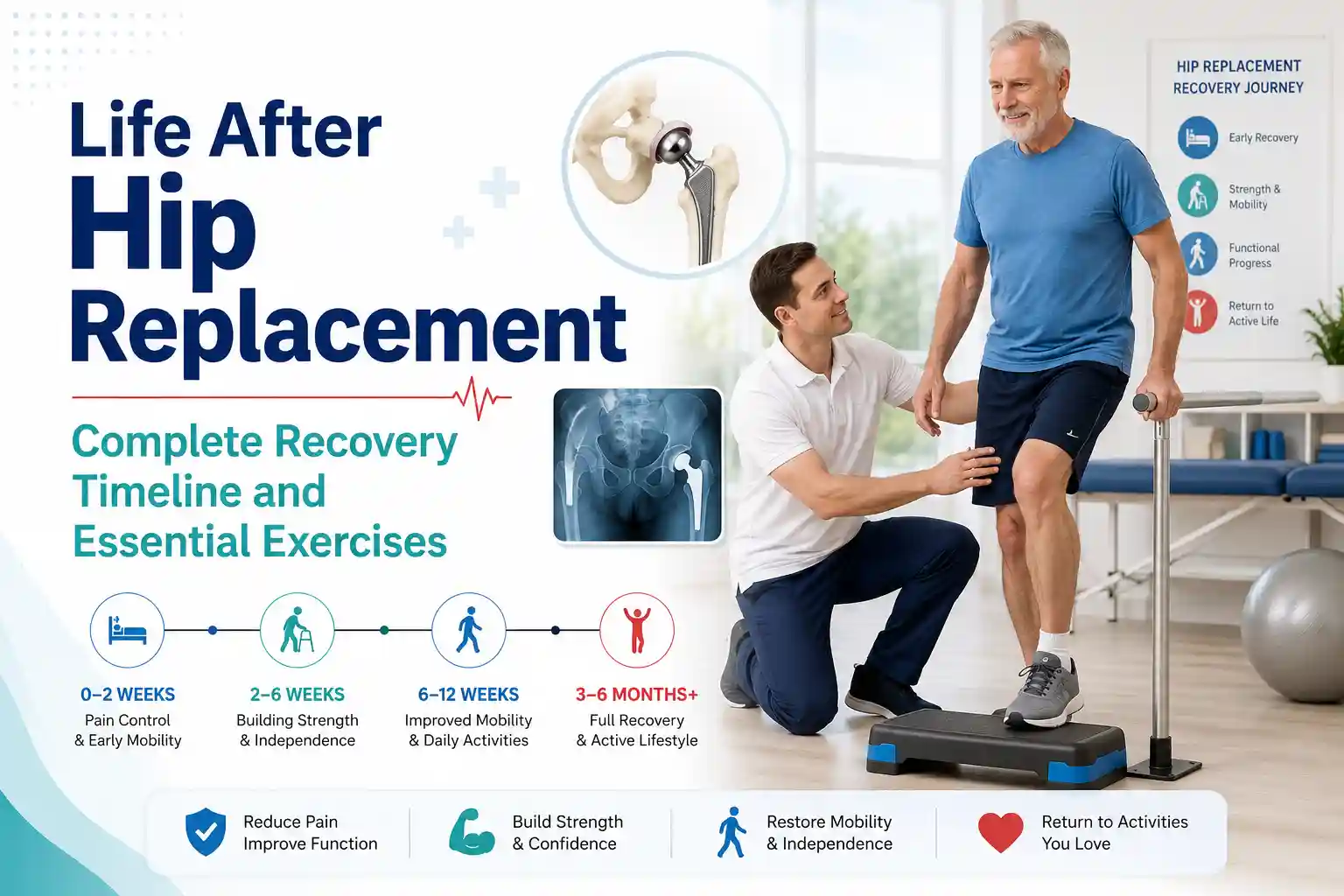
Every patient heals at their own pace. Factors such as your age, physical fitness prior to surgery, body weight, and the specific surgical approach used by the best hip replacement doctor in Hyderabad will influence how quickly you bounce back. However, a standard recovery journey generally follows these structured phases.
Phase 1: The Immediate Post-Operative Phase (Days 1 to 3)
Your recovery begins the moment you wake up in the recovery room. Modern orthopedic practices heavily emphasize early mobilization.
Day of Surgery (Day 1): You might be surprised to learn that physical therapy starts almost immediately. Within hours of your surgery, a physical therapist will help you sit on the edge of the bed and likely take a few guided steps using a walker. This early movement is critical to stimulate blood flow and prevent complications like Deep Vein Thrombosis, also known as blood clots.
Days 2 to 3: You will learn how to safely get in and out of bed, use the restroom, and walk short distances in the hospital hallway with a walker or crutches. The medical team will closely monitor your pain levels, keeping you comfortable with a tailored pain management protocol. Once you can safely perform basic movements and walk with an assistive device, you will be discharged to recover in the comfort of your own home.
Phase 2: Early Home Recovery (Weeks 1 to 3)
The first few weeks at home require patience and careful attention to your new joint’s limitations.
Wound Care and Swelling: Your surgical incision will need to be kept clean and dry. It is completely normal to experience swelling, mild bruising, and localized soreness around the hip and thigh. Using ice packs and keeping your leg elevated will help manage the inflammation.
Mobility: You will continue using your walker or crutches. During this phase, you will gradually increase the distance you walk around your home.
Hip Precautions: Depending on whether your surgeon used an anterior or posterior approach, you will be given strict hip precautions. For example, posterior approach patients are typically advised not to bend their hip past 90 degrees, not to cross their legs, and not to turn their operated leg inward. Adhering to these rules is vital to prevent hip dislocation while the surrounding soft tissues heal.
Phase 3: Regaining Independence and Strength (Weeks 4 to 6)
By the end of your first month, you should notice a dramatic improvement in your overall comfort and mobility.
Ditching the Walker: Most patients transition from a walker or two crutches to a single cane between weeks 3 and 4. As your balance and muscle strength improve, you will eventually walk unassisted.
Returning to Daily Activities: You will be able to resume light household chores and cooking. If you have a sedentary desk job, you may be cleared to return to work.
Driving: If your surgery was on your left hip and you drive an automatic car, you might be cleared to drive within 2 to 3 weeks. If the surgery was on your right hip, it typically takes 4 to 6 weeks before your reaction time and strength are sufficient for safe braking.
Phase 4: The Final Stretch (Weeks 7 to 12)
If you are wondering how long to recover from hip replacement completely, this is the phase where you begin to feel truly normal again.
- Your physical therapy will shift from basic mobility to targeted strengthening and endurance.
- You will be cleared to return to low-impact recreational activities such as swimming, stationary cycling, golfing, and brisk walking.
- While the bone completely fuses to the implant and internal soft tissues fully heal over the course of 6 to 12 months, the vast majority of your functional recovery is achieved by the 12-week mark.
5 Essential Hip Surgery Recovery Exercises
Physical therapy is the cornerstone of your recovery. A dedicated exercise routine prevents scar tissue buildup, restores your range of motion, and rebuilds the muscles that stabilize your new hip.
Here are the standard, foundational hip surgery recovery exercises you will likely perform daily. Note: Always follow the specific routine provided by your physical therapist and surgeon.
1. Ankle Pumps
Purpose: Improves circulation in the lower leg to prevent blood clots and reduce swelling.
How to do it: Lie on your back or sit comfortably. Slowly push your foot up and down, pointing your toes away from you and then pulling them back toward your shin.
Repetitions: Perform 10 to 15 pumps every hour you are awake during the first few weeks.
2. Gluteal Sets (Squeezes)
Purpose: Strengthens the gluteus maximus, also known as the buttock muscles, which are crucial for walking, standing up, and hip stability.
How to do it: Lie flat on your back with your legs straight. Squeeze your buttock muscles tightly together. Hold the contraction for 5 seconds, then slowly relax.
Repetitions: Do 2 sets of 10 repetitions, twice a day.
3. Heel Slides
Purpose: Safely increases the bending, or flexion, range of motion in your new hip joint.
How to do it: Lie flat on your back. Keeping your heel in contact with the bed, slowly slide your heel up toward your buttocks, bending your knee. Slide the heel back down until your leg is completely straight.
Repetitions: Do 2 sets of 10 repetitions, twice a day.
4. Quadriceps Sets
Purpose: Rebuilds the large muscles on the front of your thigh, also known as quads, which help you straighten your leg and support your knee.
How to do it: Lie flat on your back. Tighten the muscles on the front of your thigh by pressing the back of your knee firmly down into the bed. Hold the contraction for 5 seconds, then relax.
Repetitions: Do 2 sets of 10 repetitions, twice a day.
5. Standing Hip Abduction
Purpose: Strengthens the muscles on the side of your hip, which are vital for maintaining pelvic balance and preventing a limp.
How to do it: Stand straight, holding onto the back of a sturdy chair or a kitchen counter for support. Keep your toes pointing forward and slowly lift your operated leg straight out to the side. Hold for 2 seconds, then slowly lower it back to the floor. Do not lean your trunk to the side while lifting the leg.
Repetitions: Do 2 sets of 10 repetitions, twice a day.
Holistic Tips for a Faster Hip Recovery
Beyond structured exercises, your daily habits play a massive role in how quickly you heal. To optimize your hip replacement recovery time, integrate these holistic practices into your routine:
- Prioritize Protein and Hydration: Healing tissue requires energy. Eat a balanced diet rich in lean proteins such as chicken, fish, eggs, and lentils, along with vitamin C and zinc to promote tissue repair. Drink plenty of water to help your body flush out post-surgical medications and reduce swelling.
- Optimize Your Sleep: Deep sleep is when your body does its most aggressive healing. If you are struggling to sleep on your back, ask your doctor about safe side-sleeping positions using a pillow between your knees to maintain proper joint alignment.
- Manage Your Weight: Every extra kilogram of body weight adds up to three kilograms of stress on your hip joint. Maintaining a healthy weight will extend the lifespan of your new implant and make physical therapy much easier.
- Fall-Proof Your Home: Before surgery, remove all loose rugs, electrical cords, and clutter from your walking paths. Install grab bars in the bathroom and ensure your home is well-lit at night to prevent dangerous trips and falls.
The Importance of Choosing the Right Surgeon
A smooth recovery timeline heavily depends on the precision of the surgery itself. When you trust your care to the best hip replacement doctor in Hyderabad, you benefit from precise implant alignment, modern minimally invasive surgical techniques, and advanced pain management protocols.
Expert surgeons cause less trauma to the surrounding muscles and tissues during the operation, which directly translates to less post-operative pain and a significantly faster rehabilitation phase. Make sure you select a doctor who not only possesses exceptional surgical skills but also provides a comprehensive, well-structured post-operative care plan.
A total hip replacement is one of the most successful interventions in modern medicine, offering a true second lease on life for those suffering from debilitating joint pain. While the rehabilitation process requires dedication, consistency, and hard work, the reward is well worth the effort. By understanding your recovery timeline, diligently performing your prescribed exercises, and leaning on the expertise of a specialized care team, you will soon be walking, traveling, and enjoying life without the shadow of chronic pain.
Take the First Step Toward Better Mobility!
Are hip issues holding you back from enjoying life? Connect with us if you are facing limited mobility or severe joint discomfort in Hyderabad, and explore your treatment options with the best hip replacement doctor in Hyderabad.
Call us today at +91 998 963 5555 to book your appointment and let us help you move freely again!
Frequently Asked Questions (FAQs)
1. How painful is the recovery after a hip replacement?
While you will experience surgical pain in the initial days, it is vastly different and much more manageable than the deep, chronic arthritis pain you likely suffered from before the surgery. Your medical team will provide a multi-modal pain management plan to keep you comfortable. Most patients find that post-op pain diminishes significantly within the first 10 to 14 days.
2. Will I need physical therapy after a hip replacement?
Absolutely. While the surgeon installs the new joint, it is your job to train the surrounding muscles to support it. Physical therapy is mandatory for regaining your strength, correcting your gait, preventing a limp, and achieving a full range of motion.
3. When can I sleep on my side after hip surgery?
If your surgeon used a traditional posterior approach, you will typically need to sleep on your back for the first 4 to 6 weeks to prevent dislocation. If you must sleep on your non-operated side, you will be required to keep a thick, firm pillow between your knees. Always ask your specific surgeon when it is safe to change your sleeping position.
4. How long does a modern hip implant last?
With continuous improvements in materials like highly cross-linked polyethylene and advanced ceramics, modern hip implants are incredibly durable. Studies indicate that for the vast majority of patients, a hip replacement will function excellently for 15 to 20 years, or even longer.
5. Is it normal to hear a clicking sound in my new hip?
Yes, occasional clicking or a sensation of the joint components touching is normal, especially in the first few months as the swelling goes down and your muscles are still rebuilding. However, if the clicking is accompanied by sudden pain or instability, contact your doctor immediately.


DR. MIR JAWAD ZAR KHAN
MBBS, MS - Orthopedic, M.CH-(Ortho) Joint Replacement Surgeon
As the visionary Chairman and Managing Director of Germanten Hospitals, Hyderabad, Dr. Mir Jawad Zar Khan brings over two decades of surgical leadership to the field. He is dedicated to transforming lives through evidence-based treatments, advanced robotic technology, and a commitment to patient quality of life.